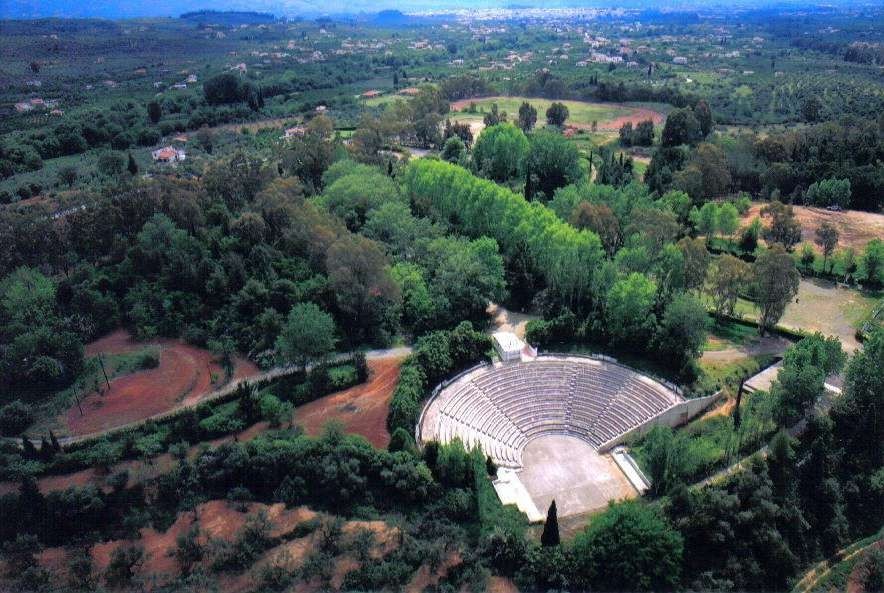
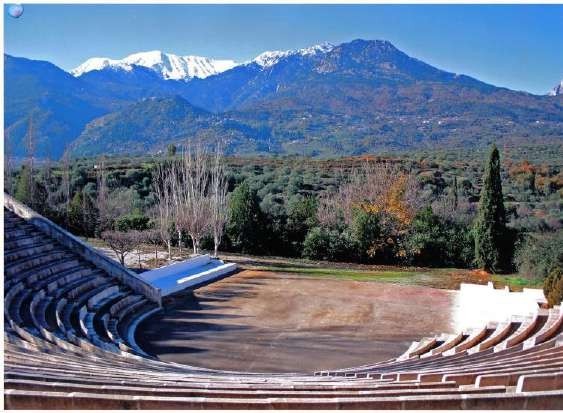
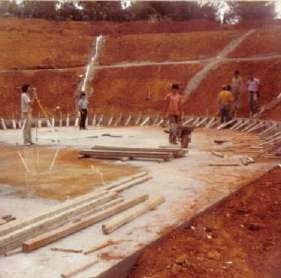
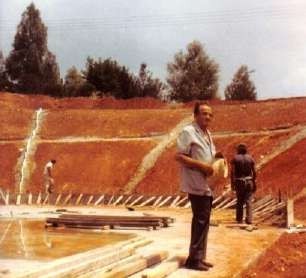
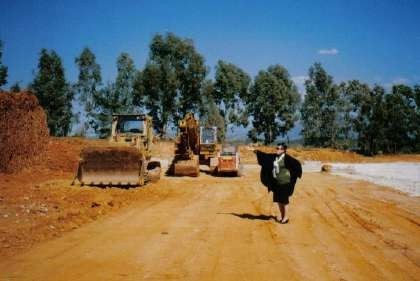
The surrounding landscape of the Sainopouleio Grove, with its natural beauty, inspired the President to envision the creation of an amphitheatre, in order to fulfil his other great dream: a substantial contribution to culture. It would be a contemporary continuation of the tradition of Ancient Sparta and its theatre, which, in its current preserved state, cannot be used. Thus, by decision of the Board of Directors, and funded entirely by the Foundation΄s own resources, the Sainopouleio Amphitheatre was built, with a capacity of 1,800–2,000 spectators and a natural stage set formed by the imposing Mount Taygetos and the Byzantine citadel of Mystras.
Subsequently, in cooperation with the competent Ministries, the Foundation proceeded to amend its Statute (Presidential Decree approved on 18 April 2002 and published in Government Gazette no. 594/15 May 2002), so that it would explicitly provide for:
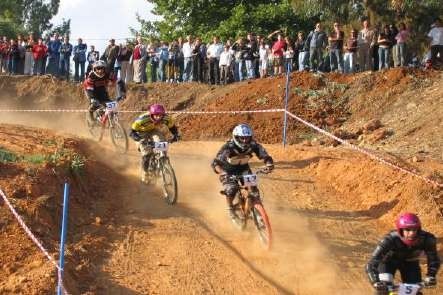
the organisation and implementation (independently or in collaboration with other bodies) of charitable, athletic, musical and, more broadly, socially oriented events in the Amphitheatre and in the surrounding area of the Foundation΄s property in the settlement of Magoula, Laconia, as well as throughout the wider area of the former Municipality of Sparta.
Since 1988, the first year of the theatre΄s operation under Mayor Demosthenis Matala, and up to the present day, the Municipality of Sparta – recognising the great contribution of the Sainopouleio Foundation to culture – has been the main co-organiser of the events. Co-organisers have also included, at various times, the Localof Municipalities and Communities of Laconia (T.E.D.K.), the Cultural and Sports Organisation of Laconia (O.P.A.N.A.L.) from its establishment under Prefect Grigoris Apostolakos and later under Prefect Konstantinos Fourkas, as well as the Municipality of Mystras. The Spiritual Centre of Sparta also participates actively in the planning and organisation.
The informal opening of the Amphitheatre took place in the summer of 1988, with a concert by the world-renowned Vienna Boys΄ Choir. The official inauguration followed in July 1990, with a concert featuring musical settings of poems by the distinguished Laconian poet and Academician Nikiforos Vrettakos, in his presence.
Since then, every summer the Sainopouleio Amphitheatre hosts the “Cultural Summer” Festival, a cultural institution that has now become firmly established for Laconia and the wider region. For this purpose, the Board of Directors has appointed an Artistic Committee, responsible for the selection, programming and curation of the events.
Over the years, the theatre΄s orchestra pit and stage have welcomed the country΄s most important artistic organisations and notable ensembles from abroad, as well as some of the greatest names in theatre and music. Indicatively: the National Theatre of Greece, the Greek National Opera, the National Theatre of Northern Greece, the Cyprus Theatre Organisation (THOC), many Regional Municipal Theatres (DIPETHE), the Camerata – Friends of Music Orchestra of the Athens Concert Hall with soloist Leonidas Kavakos, the State Ballet of the Odessa Opera, the Athens State Orchestra, the Orchestra of Colours, the ERT Symphony Orchestra, the Schenectady Orchestra of New York, the St. Georgen – Furtwangen Youth Orchestra of Germany, among many others.
During his historic concert at the Sainopouleio Amphitheatre, Manos Hadjidakis, in a brief but powerful address, described it as “the most beautiful theatre in Greece after Epidaurus”, thus placing his own seal of recognition on the venue.
The Sainopouleio Amphitheatre has also been highlighted by the Hellenic Broadcasting Corporation (ERT), which, during an official event at the Byzantine Museum in Athens dedicated to its contribution to culture, included the “Cultural Summer” in a special publication, with a photograph of the Amphitheatre and a note presenting it as one of the most successful and established cultural events in the Greek regions, where “every summer, in enchanting Sparta, the heart of culture beats strongly.”
Ticket prices are kept affordable for all spectators. Even for major theatrical and musical productions from Epidaurus and the Herod Atticus Odeon, audiences have the opportunity to enjoy performances of high artistic quality at particularly low prices. This is made possible thanks to the financial support of the co-organisers and, above all, thanks to the Sainopouleio Foundation itself, which covers the Festival΄s remaining deficit from the income of its real estate assets.
In cooperation with local cultural associations, the co-organisers provide free bus transport to and from the theatre for residents of Laconia, visitors and tourists. An organised information and ticket pre-sale network is also in place, both within the Prefecture of Laconia and in the neighbouring Prefectures of Messinia and Arcadia.
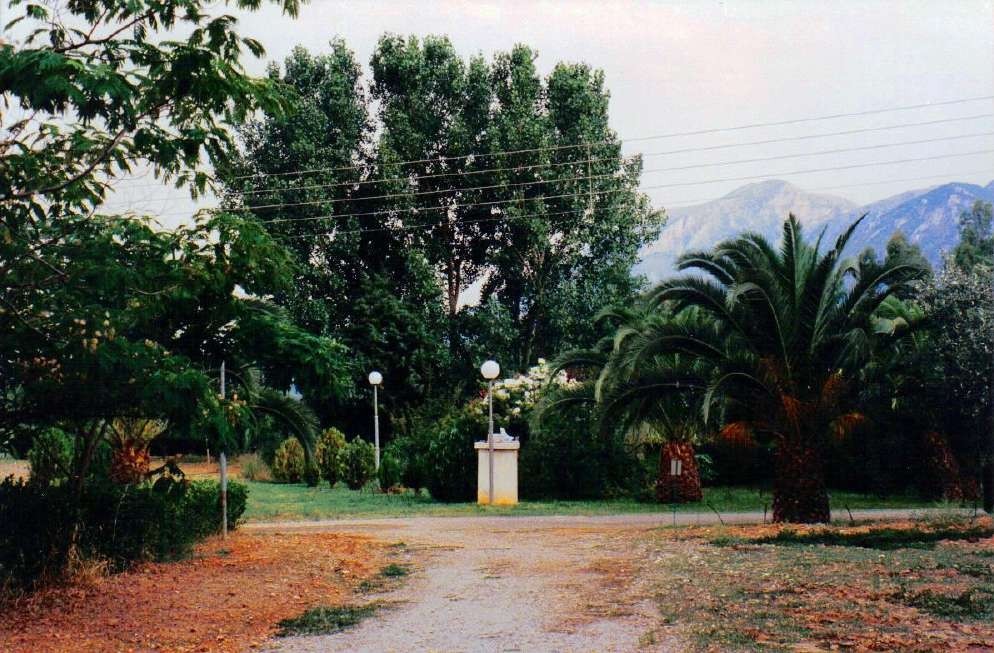
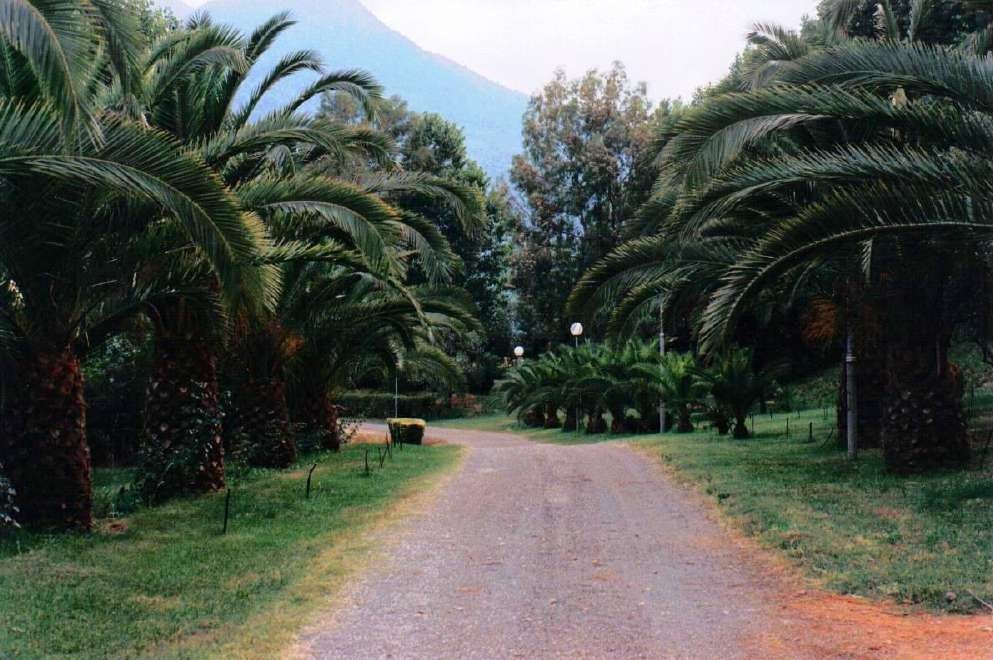
Within the Grove, the road leading to the theatre has been named the “Street of the Poets”, as it is lined with eight busts of important poets: the Laconian poets Nikiforos Vrettakos and Yiannis Ritsos (donation of the Spiritual Centre of Sparta), the ancient Spartan poets Alkman and Tyrtaeus (donation of the “Association of Lakonians in Attica”), Giorgos Seferis (donation of the Spartan Chrysida Velika), as well as the national poets Kostis Palamas and Dionysios Solomos (donation of the “Pan-Laconian Federation USA & Canada”). The “Street of the Poets” will be completed with the addition of the bust of Constantine Cavafy.
It is no coincidence that this beautiful space of culture and sport was chosen by the Department of Sports Management of the University of Peloponnese as the venue for the opening ceremony of the 2nd World Congress on Sports Management in June 2007. The congress was held under the auspices of the President of the Hellenic Republic, Karolos Papoulias, who officially declared its opening.
Beyond the main performances, the Sainopouleio Foundation organises a series of parallel events – small classical music ensembles, environmental awareness activities, theatre games, exhibitions – in selected, picturesque locations within the Grove.
Another characteristic and beloved traditional event is the “Kite-Flying Day” held every Clean Monday, co-organised with the Municipality of Mystras, in a specially selected area of the Grove. Hundreds of children from the wider region, together with their families, gather to enjoy this festive day with music, clowns, animators and the traditional Lenten delicacies offered by the organisers.
Equally important is the fact that the Sainopouleio Amphitheatre provides opportunities for local organisations and associations, not only from the city of Sparta but from the whole of Laconia, to present their work on its stage, during specific periods in the summer and in co-organisation with the Foundation. Many Primary and Secondary schools are also hosted at the Amphitheatre, giving pupils – perhaps the artists of tomorrow – the chance to experience the theatre΄s orchestra and stage and to present their own projects and performances.
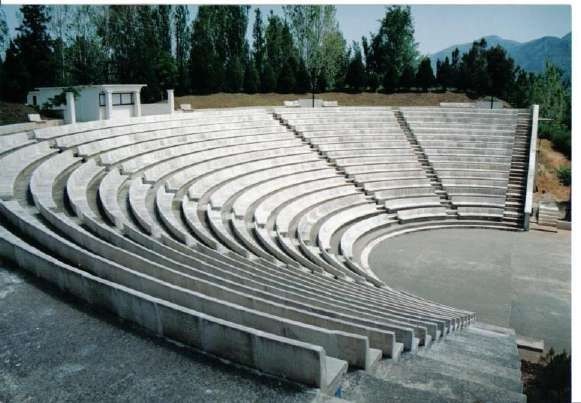
The archaeologist Stella Raftopoulou, in a text on the architecture of ancient theatres in Greece (Laconian Calendar 1999, “Idiomorfi” Publications), highlights the particular case of the Sainopouleio Amphitheatre, noting that it is a modern theatre which follows the basic principles, layout and philosophy of the ancient theatres: orientation, view, acoustics and the direct relationship between spectator and actor. It is divided into four seating sections, has fifteen rows of seats and serves around 2,000 spectators, with ergonomic seating featuring backrests throughout the auditorium, ensuring comfortable viewing of performances.
For all these reasons, major theatre organisations, with the National Theatre of Greece at the forefront, consider the Sainopouleio Amphitheatre an ideal performance venue, worthy of the history and natural surroundings that embrace it.